FAQ: You need to know this about vegan nutrition

By The Rawtarian

In this video, The Rawtarian shares the fundamentals that you need to know about nutrition when you're going raw vegan.

Video Transcript

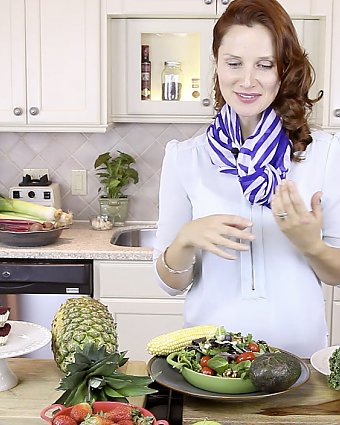
Hi, I’m The Rawtarian from the www.rawtarian.com and I am excited but a little nervous to do this little video here because as you know, I love creating raw brownies, delicious salads, Alfredo sauce – all kinds of raw vegan delights. And what I am not excited about is talking about nutritional content: calories, protein, vitamins. I do it if I have to do it. So what I am doing today is talking about two very important issues: protein and B12. As a raw vegan you need to know both of those, but I’m going to boil it down for you, those of you who are like me who are not really excited about science./

So, let’s start first with protein. What you need to know and as you explore the raw vegan diet you will be asked, “How do you get your protein?” from, you know, people who are concerned and love you such as my dad who wants to make sure I get enough protein. Because normally, people are used to having protein as meat. But what I really want to say is – yes, you can absolutely get protein from fruits and vegetables and nuts and seeds. And all you need to do is know a few things and know that you can answer with certainty, “Yes, you can get protein from fruits and vegetables. You can get an abundant amount of protein and oh yes, the example I was going to give is think of cows and horses. Think how muscular they are, how strong, how fit – and all they eat is, you know, plant foods as well. So what you need to know about protein is the average woman, there’s a crazy calculation but you could use this if you’re of average height and weight, that you need to get about 55 grams of protein per day. Now, an average dude might need around 65 grams. So there is a crazy calculation but it’s complicated. But for the sake of discussion, let’s use that.

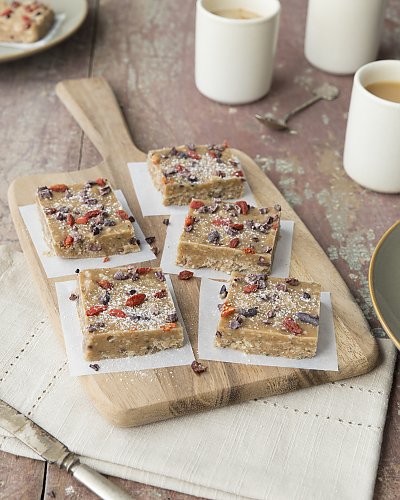
So for me, for example, 55 grams of protein would be more than enough. But how do you know how much protein that is? Well, a quarter of a cup of almonds, and four tablespoons of hemp seed hearts have about 15 grams of protein. So remember, what did I say? I was supposed to have about 55? Let’s just round it up to 60 grams of protein. If I ate, and oh my God I know it’s starting to sound scientific, but basically, if I eat, like a crazy amount of hemp seed hearts in one day, like 4 tablespoons in my smoothie in the morning, maybe 4 tablespoons again on my salad – which is delicious, with hemp seed hearts – that would be half of my needed protein for the day. And then I could get my other half perhaps from, let’s say, in dinner I might have a nut burger with almonds, maybe a quarter cup of almonds in that. And then if I had a brownie like this. This is probably not a quarter of a cup. But if I had a brownie with at least a quarter of a cup of almonds in that, that would be protein enough for the day. So now that was getting overwhelming but the gist of what you need to think about and realize is that you can totally get enough protein from fruits and vegetables.

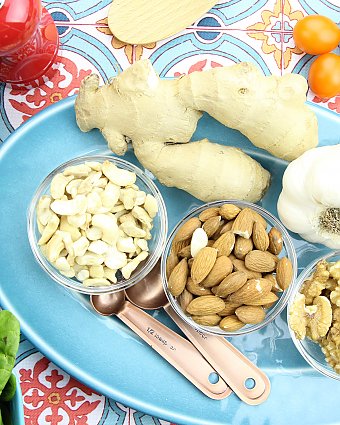
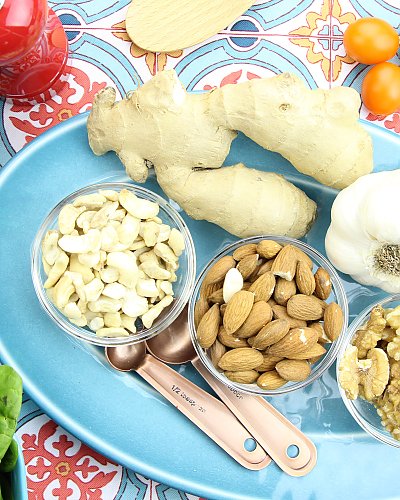
And you just want to make sure you’re consuming some of those high protein foods like almonds, hemp seed hearts, those are some of the two biggies that are really good for protein. So frequently, if it doesn’t really matter what nut you’re using, say in a raw pie crust and it calls for cashews, those have a lot less protein than almonds. I think I have them written down, cashews, the same amount, has 5 grams of protein and almonds has 15 grams of protein. So almonds have 3 times more protein than cashews. So that’s the protein issue. Yes, you can do it. But it is really important, so you do want to pay a little bit of attention just to make sure you’re getting some of those high-value protein items in your day.

Let’s leave that protein thing. If you want to know more, I do have a podcast which is basically like a radio show or an mp3 that is about protein. And that’s for free, you can download that especially if you’re like a dog walker or a jogger or a commuter in your car. Listen to my podcasts! They’re fun and they’re a lot longer and they’re easy to consume when you’re on the road.

So that’s protein!

Now the last thing I want to just touch on briefly is vitamin B12. It’s a very important vitamin. There’s so many vitamins that you could be thinking of and aware of and minerals, but as a vegan who does not eat animal products, you need to supplement with vitamin B12. I’m not big in to supplements. I don’t have like, a crazy vitamin caddy. But B12, you can’t get it without eating animal products. So if you’re not eating animal products you need B12, and if you’re deficient in B12, it can actually cause like neurological damage. So it’s very easy to supplement with it, you could take vitamins, you could take shots, or you could, there’s some food that’s fortified with B12. But anyway, the gist of this is, if you’re a vegan and a raw vegan, you need to be taking B12. And it’s one of the most important vitamins for you. So do it! And really, it is not available in plants, it just comes from animal products so you do want to make sure you’re getting enough B12. If you do happen to be getting any type of bloodwork done, they can easily check your B12 levels. And I would recommend doing that. I actually do that about once a year, just to make sure everything is sound. And for me I just take a B12 vitamin once a day and my body consumes that and assimilates very well, so my B12 levels are fabulous.

And that is really all I wanted to tell you about in terms of nutrition today. Thank you so much for watching and don’t worry, I won’t be going too heavy on the nutrition. But these two points are very important for your health, and I would be remiss if I didn’t share them with you. So thank you so much for joining me today. I’m the Rawtarian from the www.rawtarian.com, where I share plenty of simple, satisfying, raw food recipes. Thank you again for being here and I hope to talk to you soon.

RFP25: New year, new you

By The Rawtarian

To listen to the podcast click on the photo/play button above or save the MP3 to your own computer.

In this episode, Laura-Jane The Rawtarian talks about our love/hate relationship with new year's resolutions. She then details 3 changes you can focus on to help you make lasting change in your life when it comes to food.

At the end of the episode she also shares two special announcements about upcoming changes and announcements re: www.therawtarian.com.

Download Podcast

Click the button below to download the mp3 podcast file.

Download Podcast

Raw for Food Lovers Week

This week we get a little more advanced, making slightly more complex recipes like pies and cakes.

Basic Raw Food Week

This module will take you through your first week!

FAQ: When to soak nuts

By The Rawtarian

In this video, The Rawtarian explains when she soaks her  nuts and seeds and when she doesn't bother.

Video Transcript

I’m Laura-Jane from therawtarian.com and today, I’m addressing another one of my most frequently asked questions. I’ll get a ton of email and I have a tiny Word document that has a few things that I cut and paste like oh, you want to know about this? Blank. And then I cut and paste it and that I have a few things, and this is one of them.

It’s like do I need to soak my nuts and seeds is a most frequently asked question. And the question is, the answer rather, is it depends.

In my raw food recipes, if I explicitly state in the simple instructions, if I say you must soak your seeds for 2 hours—and I’m banging on my fist like this when I do it—it means yes. You do need to soak. If I do not mention it, then you do not need to soak. Occasionally, it would be optional. Here’s an example.

I have a raw cheesecake recipe available on therawtarian.com. It’s one of my most popular recipes. And in that recipe, I specifically state for the cheesecake filing, I will say if your blender Is very crappy like a $25 blender from Target and it doesn’t blend things very well, you may want to soak your nuts for half an hour to soften them. So that would be an occasional thing I might state as well.

But let’s take a step back and talk about the big picture of soaking your nuts. Some raw food gurus will say that you must always soak your nuts. And what you should do is come home, soak your nuts a few times, rinse them off, dehydrate all of your nuts, and then store them. And let’s just say I don’t agree with that.

A)I think it’s overly complicated.

B)I’m a bit confused why you’re soaking them to get rid of the enzyme inhibitors, and I’ll talk about that in a second. But if you’re going to soak them to make them more digestible and moist, then why are we dehydrating them to take all the water out as well? 

So it’s a lot of steps for very little payoff. But one good reason that I do agree with about soaking your nuts in advance, and I’ll talk about it with these beautiful walnuts that I have here today.

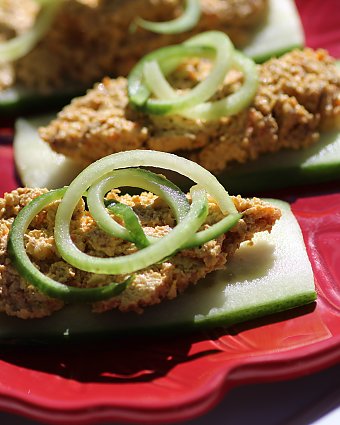
I have 1 cup that’s been soaking probably for just half an hour, and let’s pretend I was gonna make my raw walnut pate which is a very tasty one kind of like a savory spread to paste on cucumber rounds. Things like that. So I might tell you to soak your nuts in that recipe. 

And one of the reasons that we soak them is because nuts and seeds are made to grow. They are amazing. They have a protective coating called an enzyme inhibitor that basically means that when they’re sitting just like this, that they aren’t trying to grow. They actually need water to start to sprout. And even if you’ve ever sprouted alfalfa seeds, you will know that in order to get them to sprout, you need to soak them and let them dry out a little bit and soak them and let them dry out. And that is because there’s a coating on the nuts or seeds called the enzyme inhibitor that means until that coating is washed away, they’re not going to grow.

I know I’m rambling, but I will get to a point. So what I’ve done here is soak these seeds, nuts rather, for about half an hour, and that’s probably about long enough to remove that protective coating. So what I would normally do if I was making that walnut pate for example and I don’t know why I filled this bowl so full, I’m just going to dump the water out. And you could use a strainer if you need to, but I don’t know. I’m just going to dump them out. And I should have shown you the water, but the water was a little bit murky. It was a little bit tan in color because it’s removing that enzyme inhibitor and it actually comes out in the water.

But then what you want to do again is just get them wet again and rinse again. And you know I might do it. It’s easy quickly. Just a couple of times. And then we could say that these nuts  have been soaked and probably the majority of that enzyme inhibitor coating has been removed, which is great because we don’t—it’s better for you if the enzyme inhibitor has been removed.

But what it’s also done which is nice about soaking your nuts is that it does make them easier to digest. So if you have a sensitive stomach and you do find nuts give you a bit of an upset stomach, then soaking can be a good idea.

So that’s how you soak. But again, how do you when to soak and when not to soak?

Generally, I don’t soak. So these are dry walnuts. And an example here, I’ve just got a salad and I just threw some walnuts on it and I didn’t bother soaking them. I certainly could have because you could use these in the salad as well, but it depends on your level of commitment. Your practicality.

For example, I could tell you, you must only eat organic produce. 100%. That’s all you should eat. Okay, that would be nice. That would be better. Sure, we should all eat 100% organic produce, but is that practical? Can you find organic produce in your area? Can you afford it for all of the fresh fruits and vegetables that you eat? I can’t. So I think it’s important to pick and choose your battles.

So when it comes to my recipes at therawtarian.com, I know that was a long answer. Really, just if I don’t state that you need to do it, don’t worry about it and don’t soak. If I tell you that you must soak, I’m always very clear about it and I’ll explain why.

Sometimes, you need to soak so that it’s going to be easier to blend or process up. So yeah, that was kind of a long winded answer from me about whether or not to soak, and I hope that’s been helpful for you. 

And again, really just choose something that’s going to work for you and for me in my life to make sure I could stay raw for probably almost 5 years, 4 years, 4 ½ years was that I didn’t put so much pressure on myself to be perfect. I decided well, you know, I’m not going to soak all my seeds and then dehydrate them for 12 hours before eating because I don’t have time for that. So pick your battles. And thank you so much for joining me. 

I’m The Rawtarian from therawtarian.com, where I share simple, satisfying raw food recipes, and I thank you for being here and I hope to hear from you soon.


Pages